Federal-Eyalet AI Düzenlemesi Çatışması Kızışıyor: Trump'ın Dava Görev Gücü Şubat 2026'da Eyalet Yasalarını Hedef Alıyor
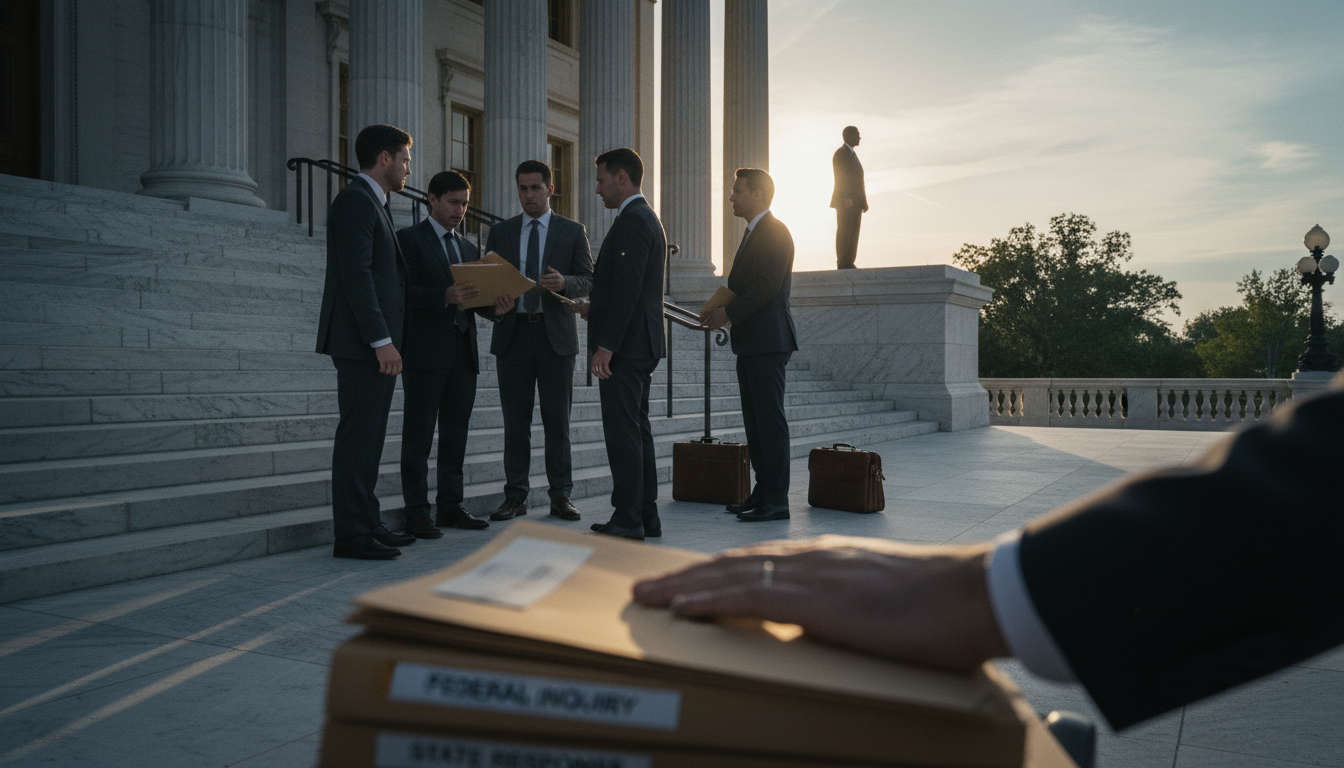
As February 2026 unfolds, the U.S. faces a pivotal federal-state showdown over AI regulation, with President Trump's December 2025 Executive Order directing the creation of an AI Litigation Task Force to challenge state AI laws that could hinder national AI dominance[1][2]. This escalating conflict pits federal preemption efforts against new state mandates in California, Texas, Colorado, and others, threatening a fragmented regulatory landscape that impacts businesses, developers, and users alike[3].
The Spark: Trump's Executive Order and the Push for Federal Control
On December 11, 2025, President Trump signed the Executive Order "Ensuring a National Policy Framework for Artificial Intelligence," aiming to establish a "minimally burdensome national policy framework" for AI while preempting state regulations through lawsuits and federal funding conditions[2]. The order tasks the Attorney General with forming the AI Litigation Task Force, whose "sole responsibility shall be to challenge State AI laws," signaling aggressive federal intervention[1].
This move responds to a patchwork of state laws taking effect in early 2026. California's Transparency in Frontier Artificial Intelligence Act (Senate Bill 53), effective January 1, requires developers of powerful AI models to implement safety protocols, conduct red-teaming, report critical safety incidents, and protect whistleblowers[1][3]. Texas's Responsible Artificial Intelligence Governance Act, also live since January 1, mandates disclosure and risk management for AI developers and deployers[1][3]. Colorado's Consumer Protections for Artificial Intelligence (Senate Bill 24-205), delayed to June 30, 2026, demands "reasonable care" to mitigate algorithmic discrimination in high-stakes sectors like employment and education[3].
The Commerce Department's 90-day evaluation of state laws, due March 11, is underway in February, compiling targets for legal challenges, while the FCC and FTC prepare preemptive federal standards[1][2]. State attorneys general in California, Texas, New York, Colorado, and Illinois are gearing up for enforcement, setting the stage for courtroom battles[1].
February 2026: The Month of Reckoning
Legal scholars view February as the tipping point for U.S. federalism in tech regulation. The AI Litigation Task Force is ramping up, prioritizing statutes like California's and Texas's for preemption under federal supremacy arguments[1]. Industry giants—OpenAI, Anthropic, Google, Meta, Microsoft, and Amazon—face cross-state compliance burdens, lobbying for federal uniformity to avoid a "patchwork" that stifles innovation[1].
State officials and civil liberties groups fiercely oppose the EO, decrying it as an overreach on traditional police powers and vowing legal countersuits. They argue state laws fill federal gaps in consumer protection, especially for AI safety and bias[2]. A prior Republican proposal for a 10-year state AI moratorium failed 99-1 in the Senate, underscoring political divisions[3]. Experts predict litigation could drag on, fragmenting AI governance and raising compliance costs for companies operating nationwide[1][2].
This isn't isolated to AI. It tests broader tensions in emerging tech oversight, from data privacy to cybersecurity, where states like Virginia (Consumer Data Protection Act) and Utah (Digital Choice Act, App Store Accountability Act) are also activating 2026 laws[3].
Expert Analysis: Fragmentation Risks and Global Implications
Doppler VPN ile gizliliğinizi koruyun
3 gün ücretsiz deneme. Kayıt yok. Günlük yok.
Analysts warn of a "constitutional clash" that could hobble U.S. AI leadership. The EO's funding threats and agency directives aim to deter states, but backlash risks politicizing AI policy[1][2]. Gunder Counsel notes the laws shape vendor contracts and third-party risks, even for startups below thresholds, via AI-specific addenda[2]. Built In highlights uncertainty from industry challenges, with Republicans eyeing dominance over safety[3].
Globally, this mirrors tensions like the EU's NIS2 Directive revisions for cybersecurity harmonization, impacting 28,000 firms by focusing on supply chains—lessons U.S. states might heed[4]. For privacy-focused users, fragmented rules complicate data handling across borders, amplifying risks in an era of AI-driven threats[5].
Privacy advocates emphasize state laws as vital checks against federal leniency, protecting against unchecked model risks[1]. However, prolonged fights could delay innovations in privacy-enhancing tech like federated learning or homomorphic encryption.
Actionable Advice for Tech-Savvy Users and Businesses
For readers prioritizing online privacy and digital freedom, this regulatory flux demands proactive steps. Here's practical guidance grounded in current developments:
For Individuals and Privacy Enthusiasts
- Audit AI Tool Usage: Review apps using frontier models (e.g., chatbots, image generators) for compliance with state laws like California's reporting mandates. Opt for tools disclosing safety frameworks—check company blogs or transparency reports[3].
- Layer VPNs and Proxies: Use no-logs VPNs to mask location-specific data flows, evading patchwork geofencing. Protocols like WireGuard offer speed for AI workloads; enable kill switches to prevent leaks during state-federal transitions [Doppler VPN uzmanlığıyla ilgili].
- Demand Transparency: When using AI services, query providers on red-teaming and incident reporting per California's Act. Switch to open-source alternatives like privacy-focused LLMs on Hugging Face for local inference, reducing vendor data exposure.
For Developers and Startups
- Map Compliance Footprint: Assess if your AI systems hit thresholds in CA, TX, or CO—e.g., high-impact models need risk docs. Use templates from Gunder's guidance for vendor addenda allocating third-party AI risks[2].
- Build Federal-Ready Stacks: Prepare for FCC/FTC standards by implementing auditable logging and bias audits now. Tools like LangChain with traceability plugins help document "reasonable care" under Colorado law[3].
- Diversify Hosting: Avoid single-state reliance; use multi-region clouds with data residency controls. Encrypt at rest/transit with AES-256, and integrate differential privacy to future-proof against discrimination claims.
For Enterprises
- Scenario Plan Litigation: Model outcomes—federal win unifies rules but weakens safety; state victories multiply audits. Budget 10-20% more for 2026 compliance, per expert estimates[1][2].
- Enhance Vendor Due Diligence: Require AI suppliers to certify under multiple state regimes. Prioritize those with whistleblower protections and incident reporting APIs.
- Adopt Zero-Trust AI: Per 2026 cybersecurity predictions, bake regulation into architecture—AI governance as "permanent design parameters." Inventory crypto assets for post-quantum readiness, as EU timelines accelerate supply chain mandates[5].
Broader Privacy and Security Ripple Effects
This clash extends to data protection. New York’s December 2025 law mandates disclosures for AI-generated "synthetic performers" in ads, with $1K-$5K fines, blending AI rules with consumer transparency[4]. UK's ICO probe into xAI's Grok for data misuse and harmful content generation underscores global scrutiny on AI privacy[4].
For VPN users, expect AI models to scrutinize traffic patterns under new governance—heightening needs for obfuscated servers and protocol hopping. Businesses should integrate AI risk into enterprise privacy programs, aligning with Virginia's data act[3].
Why This Matters for Digital Freedom
The February 2026 timeline—Commerce eval, task force actions, state enforcements—could redefine U.S. tech sovereignty[1]. A cooperative path fosters balanced oversight; clash risks balkanized innovation. Privacy advocates urge vigilance: support state AGs via public comments, push open-source audits.
Stay ahead by monitoring DOJ updates and state AG sites. Tools like VPNs with AI threat detection remain essential shields in this turbulent regulatory storm. As one expert notes, "Regulation is no longer reactive—it's architectural."[5]
(Kelime sayısı: 1,048)
Kaynaklar: